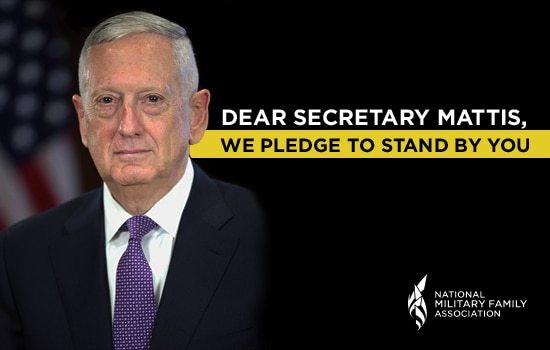
A leading military advocacy group offered its support to Defense Secretary James Mattis in a public message Monday, but also asked him to help ease some of the hardship caused by the burden of sequestration.
“Military families need your commitment to provide the necessary support to promote family readiness,” the National Military Family Association wrote in a message to Mattis, a retired Marine general who is beginning his first full week of work in the Trump administration. “Military family support and services should not be casualties of budget battles on Capitol Hill, and we are ready to arm you with the information to justify their necessity and end sequestration.”
The group also urged Mattis to fill senior leadership positions within DoD as quickly as possible, such as the undersecretary of defense for personnel and readiness, the assistant secretary for health affairs, and the deputy assistant secretary for military community and family policy. These positions provide guidance that can affect the day-to-day challenges faced by service members and families, the association wrote. “Without the required oversight and support these key positions provide, readiness will be compromised, and families will be at risk.”
The association noted that a number of big changes are pending for the military community over the next couple of years, such as the launch of a new military retirement system and changes to military health care mandated by Congress. The people in these positions will be responsible for leading these efforts.
The personnel and readiness directorate, which has oversight of a broad range of programs that directly affect service members and their families, has undergone significant turbulence over the last eight years, with numerous changes in leadership.
As the wars in Iraq and Afghanistan continue to fade from the American public’s minds, Mattis has the opportunity to help narrow the military-civilian divide, NMFA stated. “Your inspiration will show Americans that their support and understanding is critical to the well-being and success of the ones who stand on, and behind, our front lines.”
Service members still deploy frequently, although the nature of those deployments have changed, the association wrote.
“Military families still need continuous support, no matter what type of deployment they face,” the group wrote to Mattis, who is single.
Karen Jowers covers military families, quality of life and consumer issues for Military Times. She can be reached at
kjowers@militarytimes.com.