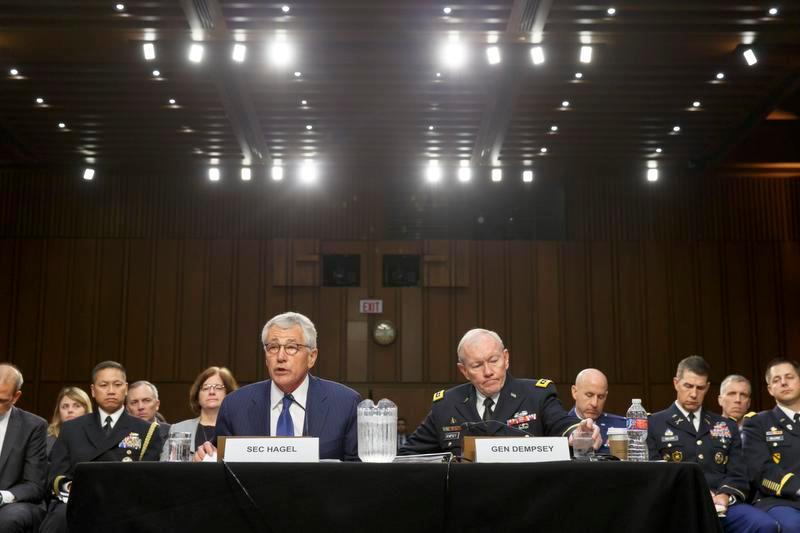
The United States is “at war” with Islamic State militants in Iraq and Syria and U.S. military ground troops may be required if President Obama’s initial strategy is not successful, the Pentagon’s top two officials told Congress on Tuesday
“We are at war with ISIL as we are with al-Qaida,” Defense Secretary Chuck Hagel said in a hearing of the Senate Armed Services Committee, using an alternative acronym for the Islamic State militants.
Hagel outlined Obama’s strategy to defeat IS militants, which includes ramping up U.S. airstrikes on IS targets in both Iraq and Syria and drumming up a coalition of other nations, including some Sunni Arab countries from the Middle East. It’s unclear who will be joining that coalition and Hagel declined to offer specifics.
Army Gen. Martin Dempsey, chairman of the Joint Staff, said he is not ruling out putting combat forces on the ground under certain circumstances. For example, U.S. ground troops might be sent into Iraq or Syria in the event that a U.S. aircraft is shot down and a pilot needs to be rescued.
U.S. combat troops could see ground-level fighting if the Iraqi security forces mount a complex mission and the U.S. forces are needed “to provide close combat advising or accompanying,” Dempsey said. He cited the hypothetical example of an invasion of a large city like Mosul.
Dempsey said a large-scale mission of ground troops may be needed if the U.S. is unable to rally a successful coalition of other nations. And Dempsey also said his views on ground troops might change if the ISIL threat appears to directly threaten domestic targets inside the United States.
“My view at this point is that this coalition is the appropriate way forward. I believe that will prove true,” Dempsey told lawmakers.
“But if it fails to be true, and if there are threats to the U.S., then of course I would go back to the president and make a recommendation that may include the use of U.S. military ground forces,” Dempsey said.
Obama said on Sept. 10 that the U.S. has “not yet detected specific plotting against our homeland.” Obama did not use the phrase “at war with ISIL” and vowed that “we will not get dragged into another ground war in Iraq.”
Obama has authorized more than 1,600 U.S. troops to deploy to Iraq, including several hundred special operations troops who will be advising Iraq troops at their brigade-level headquarters.