When junior Navy officers Alex Roodhouse and Mike Taylor were leading small gunboats up and down the Euphrates River in Iraq eight years ago, they never could have imagined how their combat experience would prepare them to launch their own company.
But now they see it as plainly as the rooster-tail wake that used to spray up behind their fast boats.
They’re co-owners of BeaverFit USA, a small startup that — fitting with its “Dam Strong” tagline — builds mobile gyms out of shipping containers. Think CrossFit “boxes” in no-kidding big metal boxes.
The pair teamed up with Tom Beaver, a former British special-operations soldier, who returned to the family bridge-building business a few years ago after leaving the military and found a new niche in metal working by supplying the military there with functional fitness equipment.
“Initially, he’d welded together — just for himself — a CrossFit rack to work out on,” Roodhouse says. “As his SAS buddies saw his rig, more and more of them kept asking him to build them one.”
The business grew from there into in one of the biggest suppliers of fitness gear for the British military.
Now, Roodhouse and Taylor are building and expanding on his designs for their customers in the U.S.
The containers — ranging from 5-foot-long lockers to 20-foot walk-ins — offer built-in storage for everything from free weights to rowing machines, while also serving as an anchor point for pullup racks, weight benches, TRX suspension trainers and battle ropes.
Drop one anywhere, from a motor pool or grassy field to a training range or remote outpost, and you’ve got an instant gym.
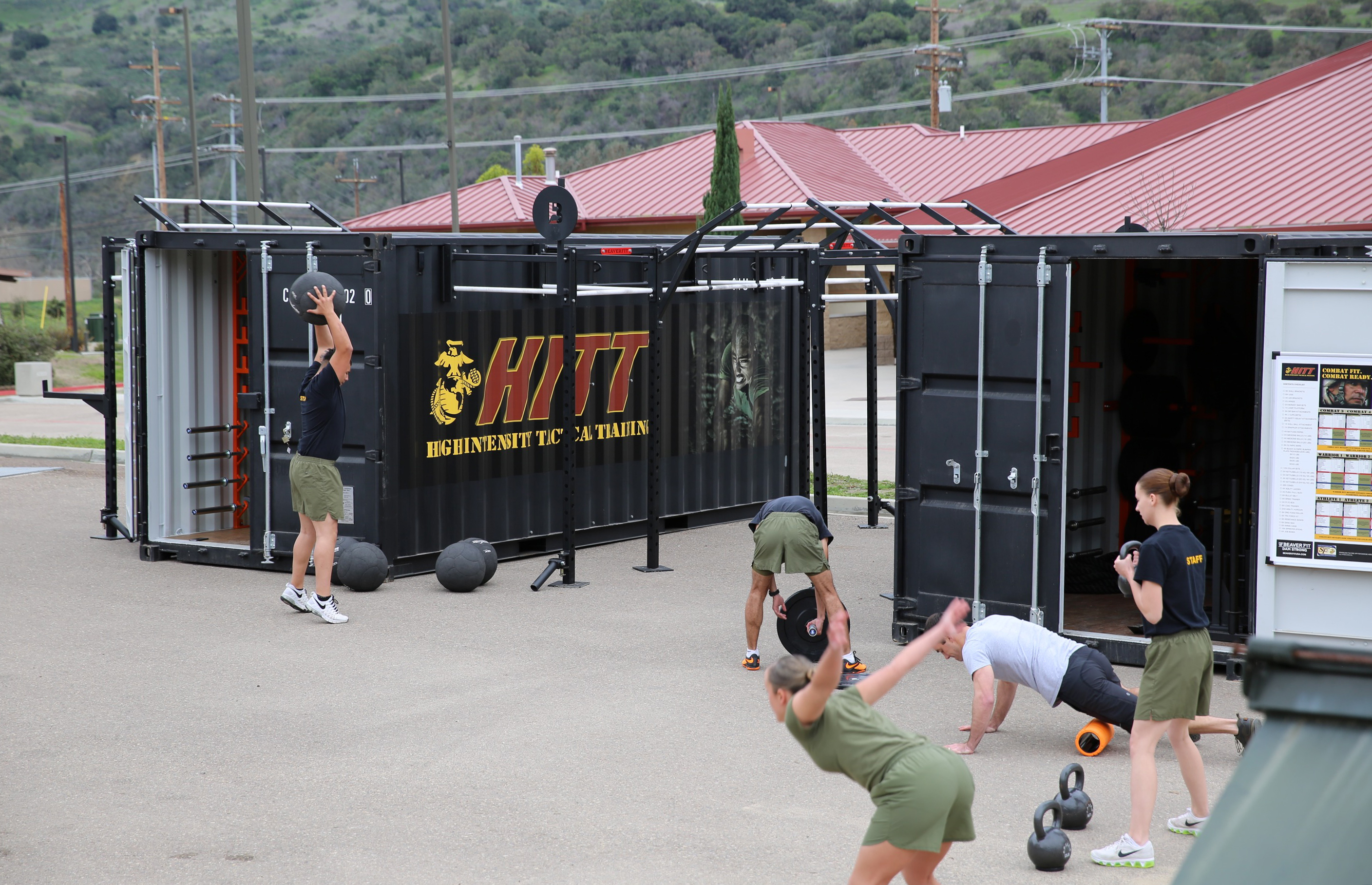
Marines work out at BeaverFit containers during the Marine West expo at Camp Pendleton, Calif.
Photo Credit: Daryl Dempsey/Courtesy of BeaverFit
In business a little more than a year, BeaverFit has already supplied a broad range of units, mostly special ops, across each of the services. The Marine Corps alone has bought 120 BeaverFit boxes, with 70 going to active-duty units and 50 to Reserve outfits.
“Reserve units especially love these because so often they’re out on their own without any real access to a base fitness center,” says Roodhouse, who like Taylor, still serves in the Navy Reserve.
Not just the military is pumped; Google also recently enlisted BeaverFit to install a workout center at the search giant’s new innovation lab.
“They did a big open-area concept on the main floor, with big glass garage-door-type openings, so it becomes this kind of indoor-outdoor space,” Roodhouse says. “It’s a beautiful setup.”
Full circle
It’s all a fitting full circle for the pair who remember how hard it was to work out consistently during deployments. In Iraq, both leaders were early adopters of the go-anywhere TRX bodyweight trainers — to a degree that, after leaving active duty, both ended up working for TRX for a few years as civilians.
“I still think TRX is a totally amazing tool to train with. But when we worked there, you kind of get tired of only being able to discuss our one tool. What I love about what we’re doing is that we’re totally agnostic. If you want a TRX-only container, you can do that. If you want a container focused on the standard MWR fitness gym or a CrossFit box, we can do those, too.”
While their experience at TRX certainly helped them start their own fitness-focused company, it was their time with the Navy’s fledging riverine fleet that both say really prepared them for the rigors of building a business once they were ready to launch out on their own.
“We’re both plank owners of Riverine Squadron 1,” Taylor says. That’s Navy-speak for the first crew of a new ship. The “Brown Water Navy” — as riverine units were dubbed — had been relegated to the history books since the 1970s when they patrolled the Mekong River during the war in Vietnam.
But starting in 2006, they were revived for duty in Iraq.
Lean startup, riverine style
“That was definitely a startup atmosphere,” Taylor says. “We had this just-figure-it-out attitude. There were no standard operating procedures. There was no personnel pipeline. It was just us and a bunch of other guys doing our own research, running our own training missions and then deploying to Iraq. It was different every day.
“The startup world is very similar,” he says. “One day it’s figuring out how to import products, the next it’s shipping out products with the right military shipping labels. Every day it’s something different. So, just like in the Navy, it’s, ‘OK, we’re going to hunker down, come up with a plan, and once that plan doesn’t work, we’re going to figure out a way to do it better.’”
It’s all about staying focused while also staying ready to adapt as the situation changes, Roodhouse adds.
“When we did our mission planning in Iraq, we had 48 guys, four Humvees and four boats,” Roodhouse says. “We would literally analyze every possible detail, but the second we left the wire, the plan changed. You knew it was going to change. The whole reason you did it was not so that you had to stay married to it, but so you had known points to deviate from. That’s exactly what we’re trying to do with BeaverFit.”
And it’s working; that lean mindset has enabled them adapt their basic concept as customers provide a continuous feedback loop for improvements or new designs.
“We’re very deliberate about that,” Roodhouse says. “We’re excited about what we’re doing in the marketplace, but we’re also just as excited about how we’re doing it as a company and the decisions we’re making internally.”
And not just in some Dilbert-esque cliché way.
One example: As they start adding employees, they plan to hire veterans as much as possible, with an eye toward recreating that military small-team atmosphere.
“We’re two guys who met in Iraq, we’ve stayed close friends since then, our wives are close friends,” Roodhouse says. “We’re all about doing this the right way, but doing it our way, the riverine way.”